Artist's News

In the studio with...
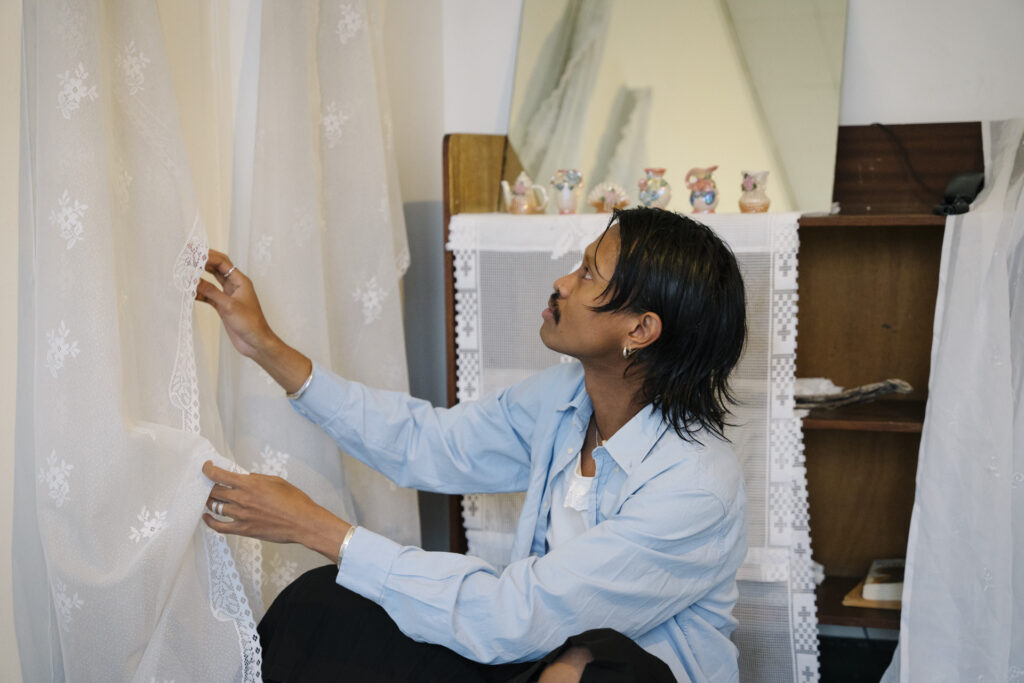
Cité internationale des arts © Maurine Tric / Adagp, Paris 2024.
As a Malagasy artist, my cultural roots play a central role in my work. My projects constantly explore my Malagasy identity and various aspects of Malagasy culture. As part of the exhibition Ridô – Dévoiler les souvenirs, I am exploring a more personal dimension, examining my roots through memories of my grandparents’ house, where I spent the early years of my life. Through this project, which may seem very intimate at first glance, I am examining the typical Malagasy home more broadly, which I believe carries a strong cultural significance.
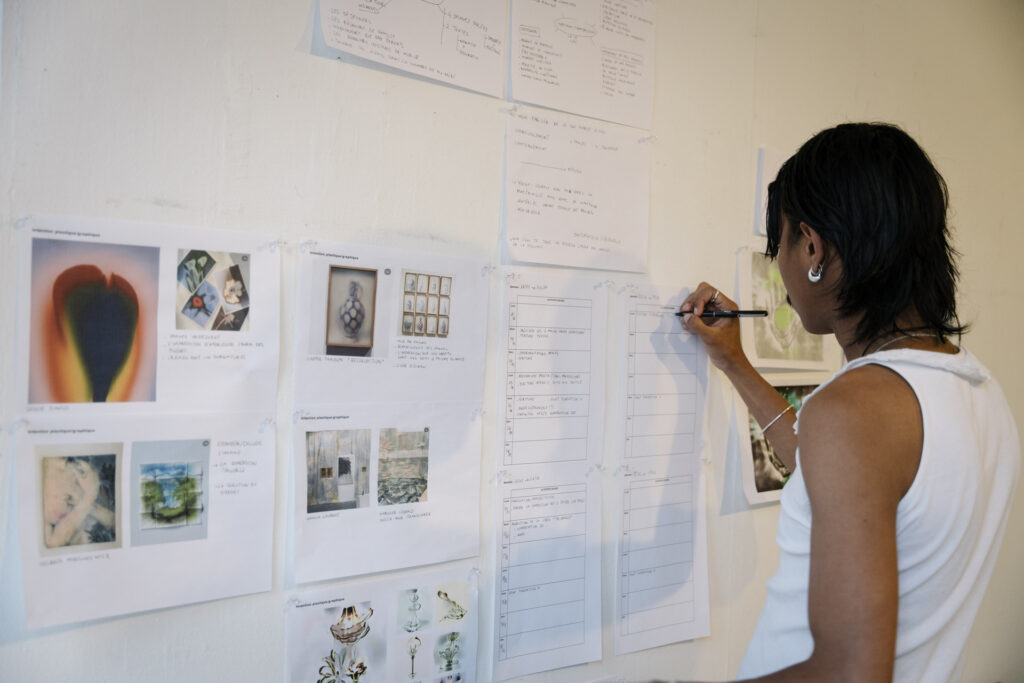
Irimboangy Tsiriniaina Hajatiana studio Cité internationale des arts © Maurine Tric / Adagp, Paris 2024.
My residency at the Cité internationale des arts provided me with an environment conducive to introspection, experimentation and reflection on my memories of Madagascar. Having a dedicated space and the time to experiment was essential in developing my work on memory. The physical distance from Madagascar also played a central role: it became both a constraint and a source of creative inspiration. Being far away allowed me to approach my memories with a detached perspective, not with the aim of recreating them exactly as they were, but of understanding them in a more poetic and sensitive way.
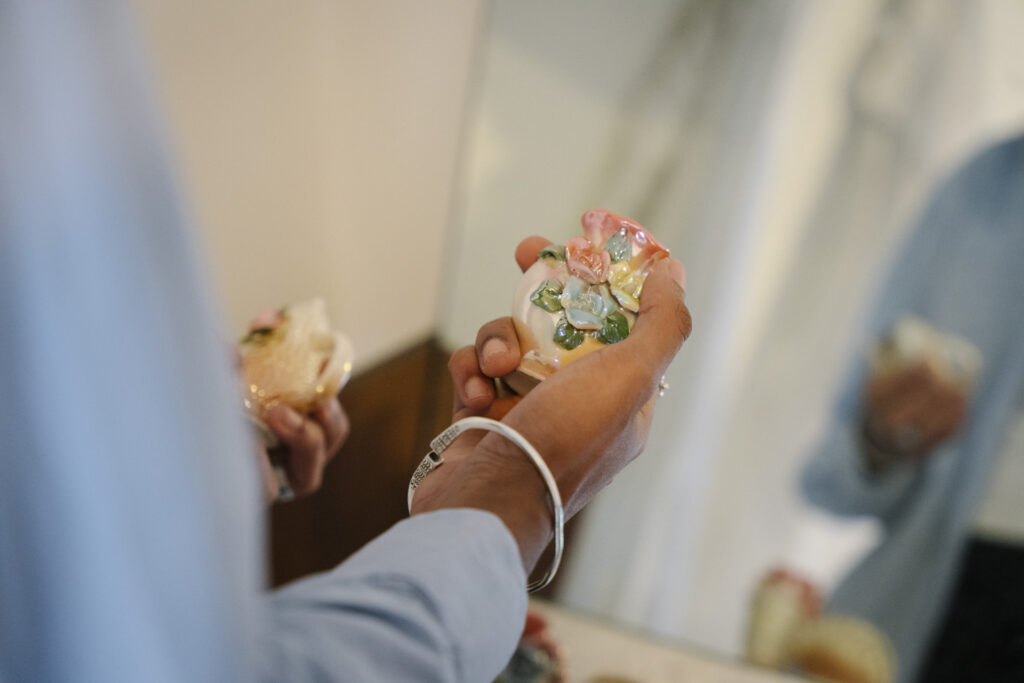
Cité internationale des arts © Maurine Tric / Adagp, Paris 2024.
The main themes I explore in my work are: memories, memory, heritage, transmission and the question of representation. These concepts lie at the heart of my artistic practice. I consider myself a visual storyteller and, in that sense, I often say that storytelling is my primary medium. Through my visual and textual works, I am committed to telling these marginalised and overlooked stories, which, in my view, deserve to be brought to light. Through storytelling, I aim to convey emotions and preserve cultural aspects linked to Madagascar. My work also incorporates an archival dimension, particularly through my family archives, where I sometimes see myself as the historian of my own family.
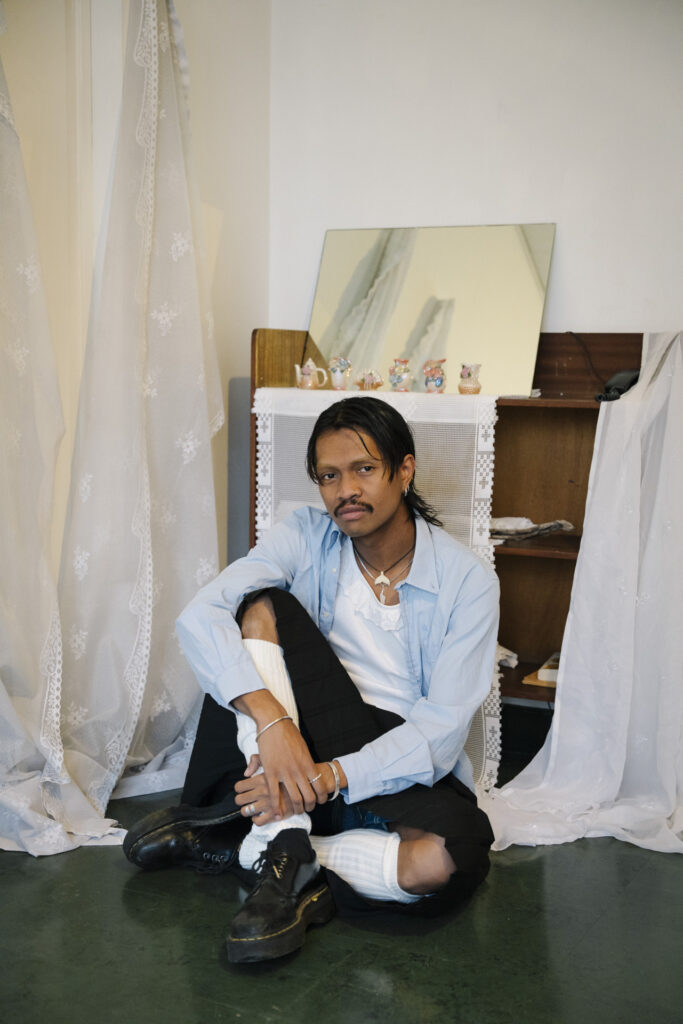
Cité internationale des arts © Maurine Tric / Adagp, Paris 2024.
Generally speaking, my artistic projects form part of a coherent continuum, always centred on the concept of Malagasy identity. My current residency at the Cité internationale des arts is a continuation of work I began several years ago. It is an ever-evolving project that aims to preserve and pass on Malagasy cultural identity whilst experimenting with new artistic approaches. In the future, I hope to continue this research, particularly in the field in Madagascar, in order to immerse myself further in local cultural practices. I would also like to take part in longer international residencies, which would provide a setting conducive to experimentation and reflection. Finally, I intend to enrich my practice by developing the textual and performance dimensions, to explore new forms of storytelling.
Born in 1998 in Antananarivo, Madagascar, lives and works between Paris and their native island.
Irimboangy Tsiriniaina Hajatiana is a digital artist and visual creator working at the intersection of research and design. Trained as a graphic designer, their practice explores various digital media and their applications, focusing on their capacity to generate new forms and images. They employ various creative technologies within a transmedia framework to address specific issues, driven by a desire to promote and preserve cultural heritage.
They also see themselves as a visual storyteller, as they are committed, through their artistic and visual work, to telling those silent and invisible stories—those on the margins of the grand narratives typically found in the collective imagination. By using various digital creative technologies such as photography, video, artificial intelligence and 3D scanning, they explore new artistic and creative avenues to realise original and sensitive projects.
Their approach aims to promote, preserve and give a voice to Malagasy heritage and culture through a transmedia approach, that is to say, by utilising a variety of media and formats. Their artistic projects combine both a search for meaning and a search for form. Indeed, research is the foundation of his artistic practice. Thus, restoring meaning to symbols, providing a representation of his multifaceted realities, and offering a fresh perspective on what may seem ordinary in Madagascar are the themes that drive his artistic projects.